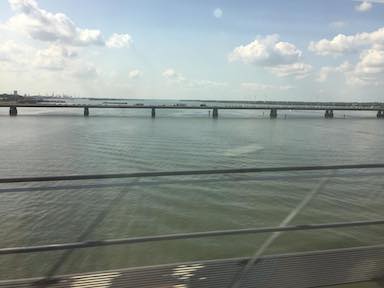
Customs formalities between Belgium and the Netherlands were eliminated a long time ago. Shortly after entering the Netherlands, at Moerdijk, the train crossed "Hollands Diep". The Netherlands has numerous waterways, rivers and canals, whose paths were artificially altered over the years. It can be confusing, but all part of successful efforts by the Netherlands to minimize flooding.
Photos of many Netherlands railway stations are now included in this web site section.
Rotterdam is generally a brief interruption in the new high speed trackage. With established trackage using the Netherlands Railways traditional 1,500 volts DC electrification through the station.
My final destination that day was Leiden. But I needed to stop at either Amsterdam Centraal Station or at Amsterdam Schiphol Airport, to present vouchers to redeem one day passes for most of my days in the Netherlands. Schiphol Airport is closer to Leiden and normally a stop for the Thalys trains. But for some reason I was unable to book the train to Schiphol, so I booked it to Amsterdam.
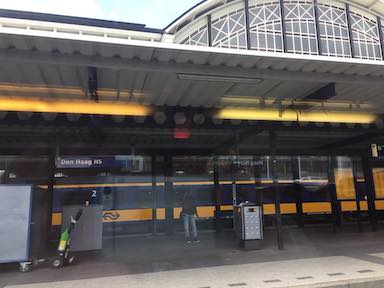
Departing Rotterdam, I eventually realized that we were not using the new direct high speed line north to Schiphol, apparently due to maintenance projects. But rather we used the older line through Den Haag, or The Hague, without stopping.
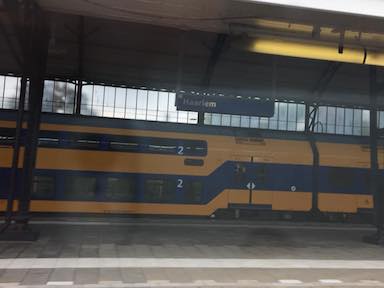
We also passed through Leiden without stopping. North of Leiden, 40 years earlier, the more direct line was under construction through Schiphol Airport to Amsterdam. But we remained on the older line through Haarlem. A name whose spelling in the US has been corrupted in a few places, by dropping an "a".
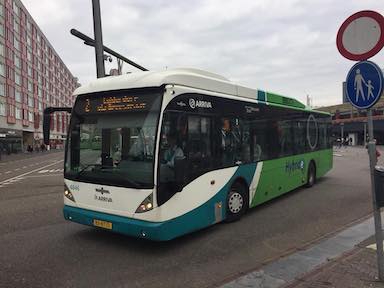
After picking up my one day passes in Amsterdam, I retraced my steps to Leiden, were I checked into the hotel. I returned to the station, to catch a bus. For many years, the regional bus company serving Leiden had been NZH, which had evolved from a streetcar and interurban system based in Haarlem, and had long since become an all bus operation. NZH stood for Noord Zuid Hollandse, or North South Holland (or perhaps something like "Hollandese"). But the regional bus systems evolved, and eventually Arriva emerged as the regional operator in the Leiden area. The pictured hybrid bus was manufactured by Van Hool of Belgium.
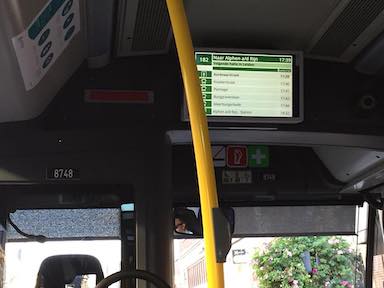
At the Leiden station I boarded a bus route 182, destined for Alphen aan den Rijn. A rather nifty display screen at the front of the bus, listing upcoming stops. I got off in Leiderdorp, which is the Leiden suburb where we had lived during my childhood. I walked around for about an hour, including by the house where we had lived. And then boarded the next bus continuing to Alphen aan den Rijn.
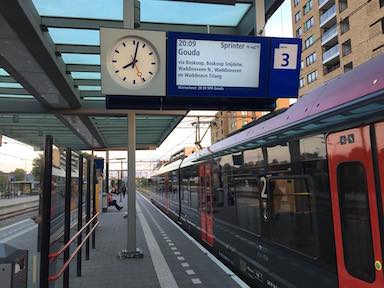
At Alphen aan den Rijn, where I would catch a train back to Leiden. These train indicators used to be on rollers, now they are digital to look like the old roller signs. The posted train (which I did not ride) was headed to a place famous for its cheese, but most Americans do not know how to pronounce. These clocks are interesting. The second hand takes maybe 58 1/2 seconds to go around. Then, an accurate centralized signal advances the minute hand, and the second hand starts going around again.
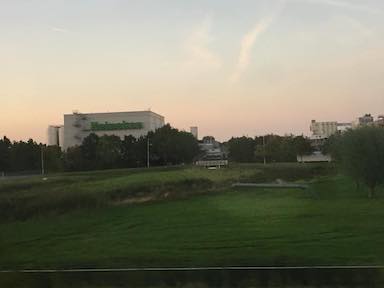
On the train from Alphen aan den Rijn to Leiden. When we lived in the Netherlands during my childhood, I used to ride my bicycle around here, in the farmlands southeast of Leiden. When I next returned to the Netherlands, I was shocked to see that this Heineken brewery had been built.